Beyond Borders: How Dual Diploma Programs Are Redefining School Education in India
With globalization and rapid advancements in technology, education in India is becoming increasingly connected with global learning systems, and learning is no longer confined within national boundaries.
Universities collaborate internationally, engage in cross-border partnerships, and welcome students from around the world, creating classrooms enriched with diverse cultures and perspectives.
In such an interconnected world, a key question emerges in modern education: should students be required to choose between their national curriculum and global academic exposure?
Dual diploma programs are gaining relevance in response to this question. It allows students currently pursuing a high school education in India to continue their local academic curriculum while simultaneously earning an internationally recognized qualification.
Academica’s Vision for Global Standards in Education in India
The Dual Diploma Program offered by Academica International Studies is built on the principle that students should not have to give up their existing curriculum in their home country to access international education.
Students studying under CBSE, CISCE, Cambridge, IB, or NIOS in India can continue their regular schooling while also working toward an American High School Diploma through additional online coursework.
About Academica International Studies (AIS)
Academica works with a network of more than 200 schools in the United States and brings over 35 years of experience in education. It offers students a structured and supportive academic pathway that strengthens future opportunities.
For students considering higher education abroad or global career paths, this additional qualification can provide a meaningful academic advantage and greater confidence when competing with talent from around the world during the application process for higher education in the United States.
How Global Standards Enhance Education in India
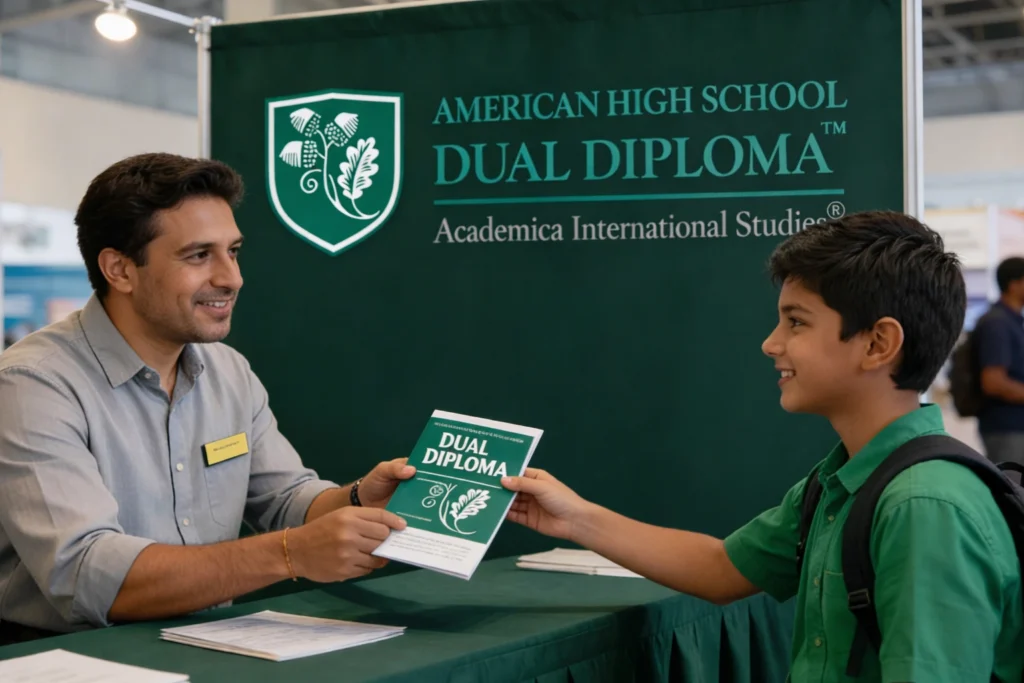
At its core, the program offers flexibility. Students can continue their education in their home country while taking courses aligned with U.S. academic standards through live interactive online sessions, right from home.
The program offers structured mentorship. The mentors track student progress, stay in regular contact, and help identify learning gaps early so they can be addressed effectively. This ensures students feel supported and confident every step of the way
Schools everywhere are exploring how digital tools can improve learning outcomes and engagement, and schools under Academica are no exception. Artificial intelligence is also becoming an important part of modern education. However, it is important to remember that technology and AI are tools and should not be used as a crutch. They can never replace human intervention.
Education, at its best, is deeply human and built on relationships, guidance, and trust.
Key Highlights
- Follows a structured yet flexible learning system
- Teachers provide regular guidance, feedback, and mentorship
- Technology is used as a support tool, not a replacement for teachers
- Helps students build confidence and expand future opportunities
Committed Faculty Shaping Education in India
As Dr. A. P. J. Abdul Kalam once said, “Teaching is a very noble profession that shapes the character, calibre, and future of an individual.”
Every student carries a unique spark, and the right teachers help students identify and nurture it. Even a small flicker of interest can grow into something meaningful when guided with care and consistency.
The Dual Diploma Program is guided by teachers who are deeply committed to nurturing young minds. They encourage curiosity and help students engage more meaningfully with their learning.
Conclusion
The Dual Diploma Program is reshaping education in India. It is more than an additional qualification and provides a stronger academic foundation for global higher education and future career opportunities. It encourages students to think beyond borders and see the bigger picture, inspiring them to broaden their horizons.
FAQ
The Dual Diploma Program in India allows students to continue their Indian school curriculum, such as CBSE, ICSE, IB, Cambridge, or NIOS while also earning an American High School Diploma through an online learning platform.
Yes. Indian students can enroll in the Dual Diploma Program in India while continuing their regular schooling. It is designed to run alongside the existing school system without replacing it.
The program is offered by Academica International Studies, which works with more than 200 schools in the United States and has over 35 years of experience in the education sector.
AIS offers flexible pathways. Students typically complete the program in 2 years, 3 years, or 4 years, depending on their grade level and academic plan.
Students learn through a structured online program while continuing their school education in India. The program follows a U.S.-based curriculum and is taught by certified teachers who guide them throughout their academic journey.
The program helps students gain international exposure, develop academic discipline, and prepare for higher education opportunities abroad, especially in countries like the United States.
Certified U.S -based teachers support students through live online classes and doubt clarification sessions. They also provide regular feedback, academic support, and progress tracking.